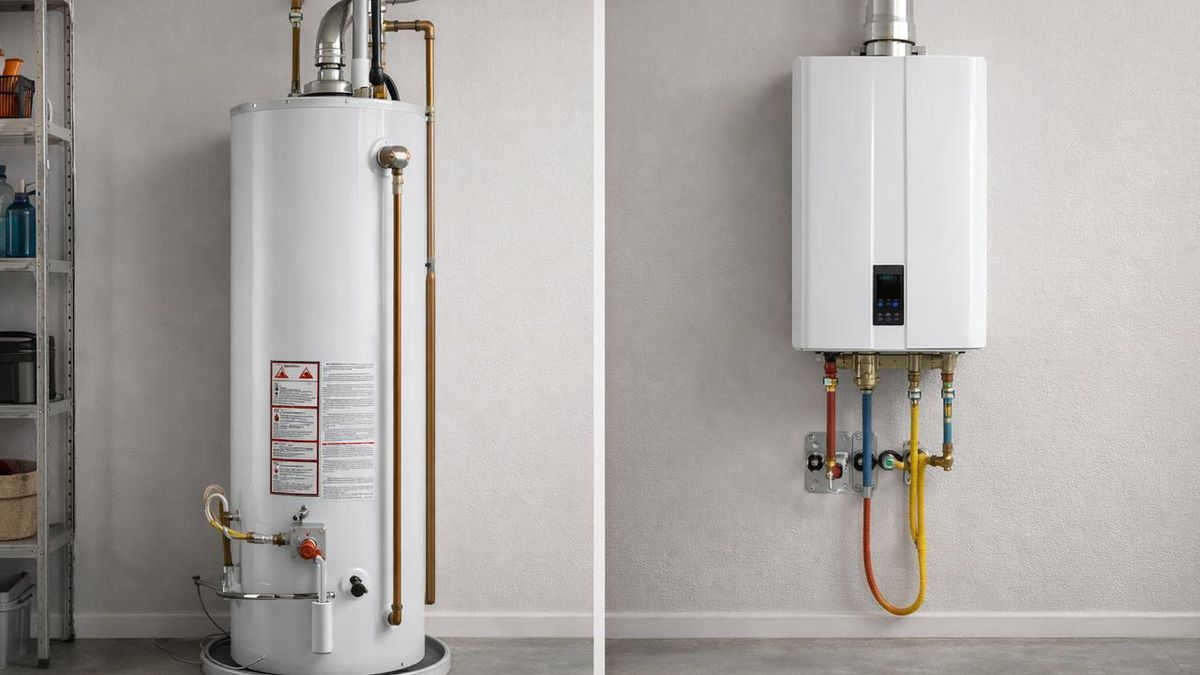
If your water heater is nearing the end of its life — or if you're building a new home in the Dallas-Fort Worth area — you're facing one of the most important plumbing decisions a homeowner can make: should you go with a traditional tank water heater or upgrade to a tankless unit?
Both options have their merits, but the right choice for your DFW home depends on several factors, including your household size, budget, water usage patterns, and the unique challenges of North Texas living — namely, our extremely hard water and wide temperature swings. Let's break it all down.
How Tank Water Heaters Work
Traditional tank water heaters store and continuously heat a reservoir of water — typically 40 to 80 gallons — so hot water is ready whenever you need it. They're powered by natural gas or electricity. When you turn on a hot water tap, heated water flows out of the top of the tank while cold water enters the bottom to be heated.
Pros of Tank Water Heaters
- Lower upfront cost: A quality tank water heater installed in a DFW home typically runs $1,200 to $2,500, including installation.
- Simple, proven technology: Tank heaters have been around for over a century. Parts are widely available and repairs are straightforward.
- Works well with hard water: While hard water causes sediment buildup in all water heaters, tanks are easier and cheaper to flush and maintain.
- No minimum flow rate: Tank heaters deliver hot water regardless of how many fixtures are running.
Cons of Tank Water Heaters
- Higher energy costs: The tank keeps water hot 24/7, even when you're not using it — a phenomenon called standby heat loss.
- Shorter lifespan: Tank heaters typically last 8–12 years in DFW, less than in areas with softer water.
- Limited hot water supply: Once the tank is empty, you wait 30–60 minutes for recovery.
- Takes up space: A 50-gallon tank needs a dedicated closet or garage space.
How Tankless Water Heaters Work
Tankless (or on-demand) water heaters don't store water. Instead, they use high-powered gas burners or electric elements to heat water instantly as it flows through the unit. When a hot water tap opens, cold water travels through the unit, gets heated in seconds, and comes out hot.
Pros of Tankless Water Heaters
- Energy savings: No standby heat loss means tankless units are 24–34% more efficient for average households, according to the U.S. Department of Energy.
- Unlimited hot water: As long as you stay within the unit's flow rate capacity, you'll never run out of hot water.
- Longer lifespan: Tankless units can last 20+ years with proper maintenance.
- Compact size: Wall-mounted units free up valuable floor space in your garage or utility closet.
Cons of Tankless Water Heaters
- Higher upfront cost: Expect $3,000 to $5,500 installed in DFW, depending on whether gas line upgrades or venting modifications are needed.
- Flow rate limitations: Running multiple showers and the dishwasher simultaneously can overwhelm a single unit.
- Hard water vulnerability: DFW's mineral-rich water can scale up the heat exchanger quickly, requiring annual descaling to maintain efficiency and warranty coverage.
- Cold water sandwich effect: Brief bursts of cold water between hot water draws can be annoying, though modern units have addressed this with buffer tanks.
Tank Water Heater
- Cost: $1,200 – $2,500 installed
- Lifespan: 8–12 years
- Efficiency: Standard
- Hot water: Limited by tank size
- Maintenance: Annual flush
- Hard water impact: Moderate
Tankless Water Heater
- Cost: $3,000 – $5,500 installed
- Lifespan: 15–20+ years
- Efficiency: 24–34% better
- Hot water: Unlimited (within flow rate)
- Maintenance: Annual descaling
- Hard water impact: Significant
The DFW Hard Water Factor
This is the factor that makes water heater decisions in Dallas-Fort Worth different from most of the country. DFW water is among the hardest in the United States, with mineral content ranging from 10 to 20+ grains per gallon depending on your city and water source. For reference, anything above 7 grains is considered "hard."
Hard water affects both types of water heaters, but in different ways. In tank heaters, minerals settle at the bottom as sediment, reducing efficiency and eventually leading to premature failure. In tankless units, minerals coat the heat exchanger, restricting flow and reducing heating capacity. Both require regular maintenance, but tankless units are more sensitive — skipping the annual descaling can void your warranty and shorten the unit's life significantly.
Our recommendation: If you go tankless in DFW, pair it with a water softener or scale inhibitor system. This protects your investment, reduces maintenance frequency, and helps the unit achieve its full 20-year lifespan. The added cost of a water softener ($1,500–$3,000 installed) pays for itself in extended equipment life and reduced energy bills.
The Texas Climate Consideration
North Texas has a unique climate challenge: our incoming water temperature varies dramatically by season. In summer, groundwater enters your home at around 75°F. In winter, it can drop below 45°F. Tankless water heaters must work harder to achieve the same output temperature when the incoming water is colder, which means the effective flow rate drops in winter — exactly when you want more hot water.
For DFW homes, this means you may need a larger-capacity tankless unit than what's recommended for warmer climates. A unit rated for 3 simultaneous showers in Florida might only handle 2 in Texas during a cold snap. Your plumber should size the unit based on DFW's winter groundwater temperatures, not national averages.
So, Which Should You Choose?
Go with a tank water heater if: You have a tighter budget, your household is small to medium-sized (1–3 people), you don't want to deal with descaling maintenance, or you're in a home you plan to sell within a few years.
Go tankless if: You have a larger household (4+ people) that runs through hot water quickly, you plan to stay in your home long-term, you're willing to invest in a water softener system, and you value the energy savings and space efficiency over the long run.
Need Help Deciding?
Our licensed plumbers can evaluate your home, water usage, and budget to recommend the best water heater solution for your DFW home.
Get a Free ConsultationAt Pro Plumbing DFW, we install and service both tank and tankless water heaters from all major brands. We'll give you an honest recommendation based on your specific situation — not a sales pitch. Contact us today or call +1 817-634-PIPE (7473) for a free consultation.
Frequently Asked Questions
Which is better for DFW homes: tank or tankless water heater?+
For most DFW families, tank water heaters offer the best value with lower upfront costs. Tankless units are ideal if you want endless hot water, energy savings, and plan to stay in your home long-term.
How much does a tankless water heater cost in DFW?+
A tankless water heater installation in DFW typically costs $2,500-$5,000 including the unit and installation, compared to $800-$2,000 for a traditional tank water heater.
Does DFW hard water affect water heaters?+
Yes, DFW's hard water causes mineral buildup that reduces efficiency and lifespan. Annual flushing is recommended for tank heaters, and tankless units need descaling every 1-2 years.
How long do water heaters last in Texas?+
Tank water heaters last 8-12 years in Texas, while tankless units can last 20+ years with proper maintenance. DFW's hard water can shorten lifespan without regular flushing.